Practical perspective
Reactive electrical maintenance begins after a fault has already affected performance, safety or access to power. The immediate repair may be necessary, but repeated dependence on emergency intervention creates a much wider cost burden.
In commercial buildings, estates, retail environments and public facilities, electrical systems support lighting, security, communications, pumps, access control, equipment and daily operations. A localised defect can therefore affect more than the failed component itself.
A stronger maintenance model combines prompt fault response with routine inspection, trend analysis, testing, prioritised corrective work and proper close-out records.
The true cost of reactive electrical maintenance includes downtime, repeat call-outs, temporary workarounds, secondary damage and management time—not only the electrician’s invoice.
The repair invoice is only one part of the cost
When an electrical fault occurs, the direct cost is easy to recognise: labour, call-out fees, replacement components and any specialist equipment required to restore the system. The indirect costs are often spread across several departments and therefore receive less attention.
Emergency response
Unplanned call-outs, expedited procurement, after-hours access and urgent coordination can increase the effort needed to complete otherwise routine work.
Operational interruption
Staff, tenants, customers or site users may lose access to lighting, equipment, lifts, pumps, security systems or work areas.
Secondary damage
A persistent electrical problem can affect connected equipment, protective devices, cabling, controls or adjacent components.
Management time
Facilities, procurement and operations teams must redirect time towards access, approvals, communication, supervision and incident close-out.
A low-value repair can still become an expensive event when it interrupts a high-value operation or repeatedly returns without a confirmed root cause.
Downtime and operational disruption
Electrical failures rarely occur at a convenient time. A tripped circuit, failed light circuit, damaged distribution component or unreliable supply can interrupt access to essential spaces and place immediate pressure on facilities teams.
In live environments, the response must account for more than technical repair. Teams may need to isolate affected areas, redirect occupants, arrange temporary lighting, communicate with tenants, protect sensitive equipment and complete work outside normal operating hours.
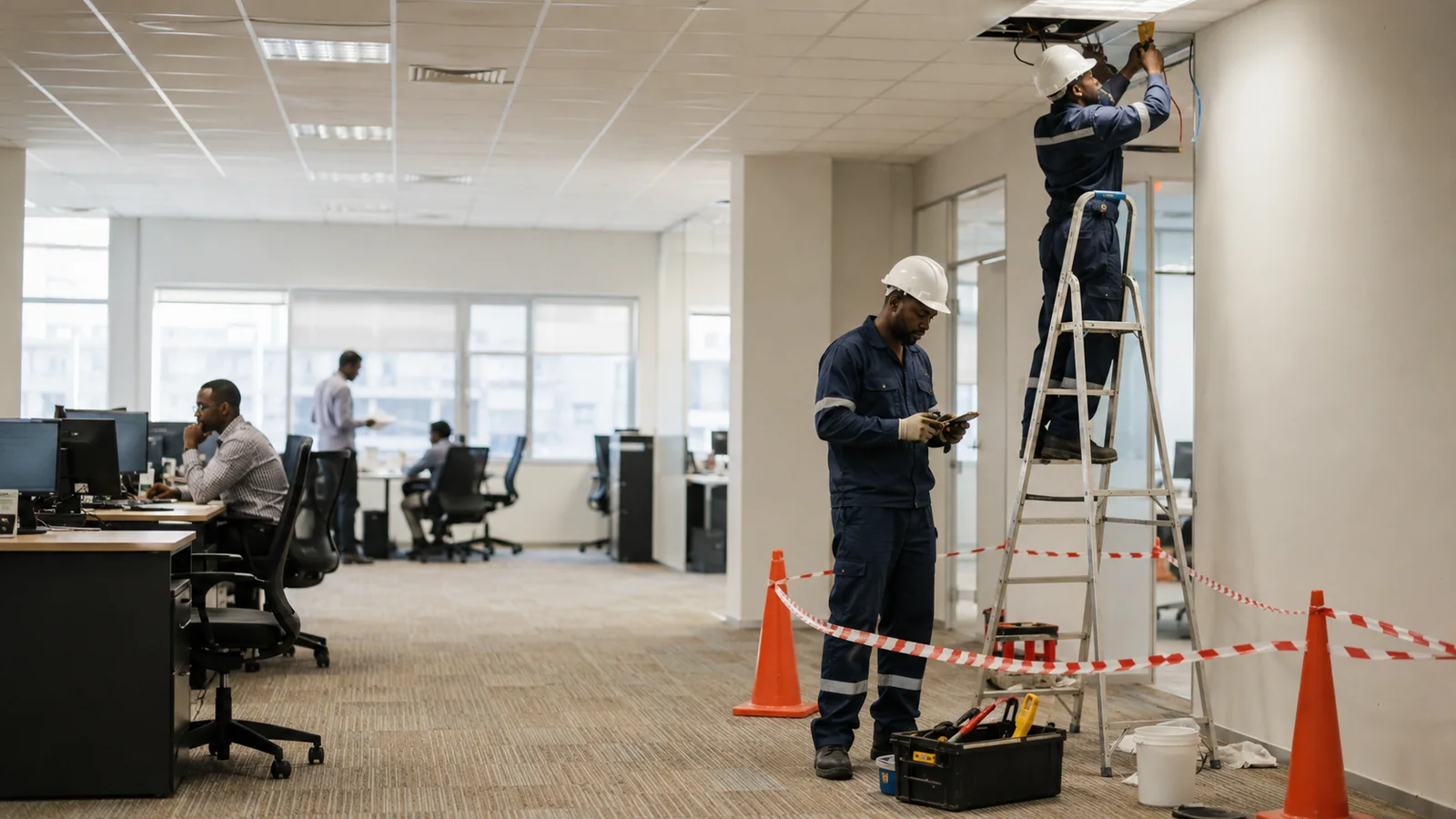
Controlled electrical work requires clear isolation, access planning and communication with affected site users.
Planned electrical maintenance
- Work scheduled around operational requirements
- Known access, isolation and approval arrangements
- Components sourced before the intervention
- Testing and records completed as part of the scope
- Corrective actions prioritised by condition and risk
Repeated reactive work
- Unplanned access and disruption
- Immediate pressure to restore power
- Temporary solutions may remain longer than intended
- Limited time for broader condition assessment
- Recurring faults can be treated as isolated incidents
Safety, compliance and asset exposure
Electrical defects should not be evaluated only according to whether equipment continues to operate. Heat damage, loose connections, damaged enclosures, overloaded circuits, moisture exposure and repeated tripping can indicate conditions that require investigation.
- Repeated tripping or unexplained loss of supply
- Burning smells, heat discolouration or unusual noise
- Loose, damaged or exposed electrical components
- Flickering lights or unstable equipment performance
- Temporary connections that have not been formally closed out
- Missing labels, schedules, test results or maintenance records
Where electrical work is completed, the scope should include the necessary testing, verification and documentation appropriate to that intervention. This creates a clearer record for future maintenance and internal approval.
Repeated operation of a protective device is a symptom that should be investigated. Resetting it without establishing the cause does not resolve the underlying condition.
Why recurring faults keep returning
A reactive visit is often performed under time pressure, with restoration of service as the first objective. That response is appropriate during an outage, but it should be followed by enough investigation to determine why the fault occurred.
Symptoms can hide broader system conditions
A failed component may be the visible point of failure rather than the original cause. Load changes, poor connections, environmental exposure, deterioration, inappropriate component selection or changes to downstream equipment may all contribute to repeat incidents.
Record the fault accurately
Capture the affected circuit, time, operating conditions, observed symptoms and any recent changes to the system.
Restore service safely
Complete the immediate work needed to make the area safe and recover the required operation.
Investigate the contributing condition
Review connected equipment, loading, protection, terminations, environmental conditions and previous fault history.
Define permanent corrective work
Separate the emergency repair from any broader upgrade, replacement, testing or remedial scope still required.
Verify and close out
Record what was completed, the test or inspection outcome, outstanding risks and recommended follow-up actions.
A practical planned-maintenance framework
Planned electrical maintenance does not require every component to be inspected at the same frequency. The programme should prioritise systems according to condition, criticality, operating environment and the impact of failure.
- Maintain an accurate register of distribution boards and critical electrical assets
- Keep board labels, circuit schedules and isolation information current
- Review recurring faults and repeat call-outs by asset or location
- Inspect for visible damage, heat, contamination, moisture and deterioration
- Plan testing and corrective work around access and operational requirements
- Record findings, completed work, photographs and outstanding recommendations
The resulting plan should distinguish routine inspections from urgent corrective work, statutory or specialist requirements, and longer-term system upgrades. This allows management teams to allocate budgets and approvals more deliberately.
How clients can reduce reactive exposure
The most useful first step is to review what the site already knows. Job cards, incident logs, tenant complaints, inspection findings and repair invoices can reveal where repeat expenditure and operational risk are concentrated.
Identify repeat faults
Group incidents by board, circuit, asset and location instead of treating every call-out as unrelated.
Prioritise critical systems
Give earlier attention to systems whose failure affects safety, security, water, access or core operations.
Separate temporary and permanent work
Track temporary restoration measures until the approved permanent corrective scope is completed.
Improve documentation
Require clear findings, photographs, test information, work completed and recommendations after each intervention.
Plan access early
Coordinate isolations, operating hours, tenant communication and permits before planned electrical work begins.
Review the programme
Use maintenance history to adjust inspection frequency, budgets and replacement priorities over time.
Frequently asked questions
Frequently asked questions
Practical guidance for facilities managers, property teams and organisations responsible for electrical reliability in live environments.
Reactive electrical maintenance is work initiated after a fault, failure or loss of performance has already occurred. It includes emergency fault-finding and repair. It remains necessary, but should be supported by follow-up investigation and planned maintenance where recurring or high-risk conditions exist.
The repair may involve unplanned call-outs, urgent procurement, after-hours access, downtime, temporary arrangements and management time. Repeat faults can also create further expenditure when the underlying cause is not identified and permanently addressed.
Repeated tripping, heat, burning smells, unusual noise, damaged fittings, flickering lights, unstable equipment and visible deterioration should be reported promptly. The affected area should be managed according to the site’s safety procedures until a competent assessment is completed.
It should identify the asset or circuit, describe the reported fault and findings, record the work completed, include relevant test or inspection information, note photographs where appropriate, and clearly identify any outstanding risk or recommended corrective action.
From response to control
Reliable electrical maintenance is built on evidence.
Reactive repair will always have a place in facilities management. The goal is not to eliminate emergency work, but to reduce preventable incidents and make every intervention contribute to a clearer understanding of the system.
When organisations track repeat faults, prioritise critical assets, plan inspections and require structured close-out records, electrical maintenance becomes more predictable and less disruptive.